Friday, November 21, 2014

Choose your life!

 
Every Peace Corps country has a Gender and Development (GAD) sector. This sector is devoted to empowering the youth and gender groups of the host country nationals. This year was the first year PCP put on a Men's Health and Finance Seminar. I sent a member of my community to this week long seminar and he returned to the community eager to show me what he had learned. Topics were covered from gender roles, self esteem and personal goals, finance tips, leadership roles and group conflict resolution. I am hoping he will be a counterpart for the reforestation project in my community, and I am encouraging him to use what he learned in upcoming reforestation meetings.
 
Furthermore, a popular workshop thru GAD is called “Elige tu vida” or “Choose your life”. A few volunteers in the surrounding area and myself planned this workshop in Bajo Cedro, a community about 15 minutes by bus from me. My community does not have a high school so several muchachos travel to Bajo Cedro after they finish elementary school. Even though I helped out in this workshop away from Santa Marta, I was still able to have an effect on the muchachos from my community.
Elige Tu Vida -Choose Your Life-  is a five-hour workshop designed to help young Panamanians critically think about their futures. Developed by Peace Corps Panama volunteers a few years back, ETV is broken into three main themes: self discovery, goal setting, and sexual health. Within each category are a series of fun charlas, or mini-discussions. During the self discovery section, kids identify their most important values and individual strengths.  My favorite activity in this portion is “Bucket Filling.” The charla talks about the power of words, the ability we each have to fill the tanks of one another and ourselves through positive affirmation and compliments. After writing three self-identified strengths, each kid writes and receives a note – a bucket filler- from three classmates. This is hard for some of the participants- I would say that compliment giving is not done frequently within the Comarca- but the smiles, the laughs, the fuller tanks is always one of the most heartwarming and fun moments of the day.
(Bucket Filling is actually something practiced within the volunteer community as well. At most training events, we make our own buckets – decorated envelopes- and are encouraged to leave notes to our amigos during the week.  At least half the bucket fillers are jokes, puns, and nonsense and the rest genuine sweet and short words of praise. I guess bucket filling as a nearly 23 year old might seem a bit silly, childish, and forced, but nearly all my PCV friends have that envelope kept somewhere in their house, taken out for reassurance and a chuckle in the moments of doubt, failure, and uncertainty. )
In part two, goal setting and future planning, we talk about the difference between dreams and goals (It doesn’t cost anything to dream) and help participants develop both short and long term goal plans. In this section we bring up different professions, talk about university opportunities, and encourage the students to think about what they can do now to better the likelihood of achieving their goals. I like ETV because it is realistic. Most of the particpants said they wished to pursue some sort of profession after going to college. But the reality of their futures is not as shiny- only 18% of Ngabes aged 15-19 study past sixth grade.
Though one of the goals of Elige Tu Vida is raising that dismal statistic, we are not naive to think a day of ETV will result in soaring graduation rates. But hopefully it has some impact.  These kids have genuinely never set goals, never written to-do lists, never thought hard about the road they’ll take to arrive to their future destination. The resources are limited- the nearest 10th grade is an hour and a half hike away, there is never enough money to pay for new uniforms of notebooks, they have no access to internet, resource books, or libraries. The have a fight ahead of them, a fight most kids in the United States don’t have, and we try to be realistic at this section. I hope deeply that the future will provide more opportunities and the kids WILL become teachers and engineers, but reassure them that it is okay to change plans. Sometimes life throws obstacles we can’t dodge. Sometimes they hit us hard and knock us off our feet and when we finally stand up again, we envision a different future. During this section we are adamant in encouraging continuing education, because education IS what will change the future, but also make sure to note that staying in the Comarca, working in agriculture doesn’t mean you are a failure.
The future planning section finished with without a doubt is the favorite charla of the day.. The Baby Game. In the Baby Game, we chose a participant (the most “muchacho” in the class) to help us out in acting out a fictional story. The scenario is as follows: each month, if the student maintains a GPA above 3.5 (on a 5 point scale) he receives an educational stipend of $50/month. (In reality, it’s actually $30/month.) He then has to pay half of it for transportation to and from his school. Once at school, he has to shell out cash for new notebooks, dictionaries, etc. At the end of the month, if he has leftover money (which at the beginning he always does), he gets to do a fun activity with his friends- go to a fiesta, buy phone minutes, etc. This portion is fun- he actually gets fake money, and we as volunteers make sure to ham up the interactions by playing over the top teachers, chiva drivers, and narrators.
 
In the second month we find out he has a girlfriend- which in this scenario I was the girlfriend.. His GPA drops, but it’s still high enough to receive the monthly stipend, and he continues through the cycle. As the months progress, his GPA continues to lower. We find out from the teacher he is spending more time with his girlfriend than in class, and we get to meet his lady friend with a surprise for the student.. A BABY! The reaction at this point is a deafening roar of laughter and disbelief. The baby mama is always hilarious and over the top (easy for me to do)  and the participants eat it up.
The cycle continues until eventually his GPA drops so low that he doesn’t receive the money, anything he has saved has gone to taking care of the baby, and to support the family he must drop out of school and work a menial, low-paying job chopping down the forest with a machete for ten hours a day. At the end, we review what the goal of the student was at the beginning of the dramatization, what changed, and the obstacles that prohibited him from achieving  it.
Me surprising my man with a baby!
 
After a discussion of the obstacles we then transition into more serious topics: HIV/AIDS, STI transmission, birth control, etc. First we start by quitar la pena, or throwing all our embarrassment out the window, by breaking up by sex and having each write down slang and dirty words for the other private parts. This is great, and more than anything, a great learning experience for the volunteers. These kids are creative! From that point on, we establish we are mature and only use the scientific names: vagina and penis.
Next, we dramatize how HIV weakens the body through an interactive “fight” activity, dispel myths on how HIV is spread, and mimic the transmission through an activity called Glitter HIV. In the game, without explaining why, we ask two students to wear socks on their right hand, a partner to hold each others hand, and two who keep their hands firmly in their pocket. We then simply say we are going to mingle and greet one another through a handshake. Unknowingly, one of the volunteers has started with glitter on their hand, and through the activity as hands are shook, the glitter is spread. At the end, we ask participants to look down and they are shocked by the red sparkles spattering their palms. We explain how one person started with glitter, or the STI, but as we shook hands ( representing sex) the glitter spread. Though not everyone shook the person’s hand who started with the glitter, almost everyone has it by the end. We then review the ABC’s of disease prevention: Absintencia (Abstinence), Bien Fiel (Being Loyal), and Condones (Condoms).  
The final activity of the day is without a doubt the one that gives students the most pena, or embarrassment. We perform a pretty funny skit of a young couple preparing to have sex for the first time, but completely clueless about using condoms. There’s a part where he opens it with a machete, asks if he can wash it after use and throw it on the roof to dry and reuse, and put it on the morning before the evening deed’s to be done. After consulting the advice of an older friend, we show correct condom use (from checking the expiration date to disposing it after use) and then break into partners to practice putting condoms. ( Some use bananas, we used finger pistol penises.) There is so much giggling, so much unwillingness to touch the condoms, but we break ‘em down eventually. Then we blow them up into balloons and finish with a game of condom balloon hot potato.
The day is dynamic, fun, and exhausting for participants and facilitators alike. This was my first Elige Tu Vida, but I would enjoy participating in more.. Like much of our work as Peace Corps Volunteers, it’s hard to say what impact we really have. I know that most of these kids will probably not go to college, many will drop out before the finish highschool to start, or because of, having children. But there’s always the glimmer of hope that one kid took what we said to heart, one kid will continue goal setting, continue school, continue making smart decisions. And for us, that one kid matters.
I will be participating in a GAD Summer Camp in February which is an extended version of ETV so stayed tuned!
  
Bajo Cedro 9th Grade Class and the PC team!

Sunday, November 16, 2014

Birthdays, holidays, anniverseries and funerals...Oh my!


The month of October and November have been slow in regards to work, but busy because it is a time full of activities. It is a time of holidays, dance, games, and food. In other words this ex-vegetarian has seen more animals slaughtered these past 2 months than she’s ever seen in her life.

There has been 3 birthdays this month; one in particular I helped in the slaughtering of a pig. It’s quite the task and felt myself a little queasy at moments but I did learn a lot of new anatomical vocabulary in Spanish. In sharing my culture, I have been teaching families how to make brownies and “no bake” cookies.  There is an abundant amount of cacao here, but since most only sell the seeds, many do not take the time to enjoy the chocolate themselves!
 
Birthday Pork hanging from the patio


Mickey Mouse pinata! Unfortunately no one knew who he was...
 
The teachers decided to celebrate the school anniversary for the first time since the school’s history. Every class put on a presentation, sharing some aspect of Panama’s culture. There was dance, songs, and plays. Other schools from surrounding communities also attended and after the presentations the students played volleyball and baseball.  

November is a cluster of important holidays in Panama. I present a very short yet ”accurate” history. The Great Nation of Panama was founded in on November 3rd, 1903 when the occupants of a tiny isthmus said, "Hey, cut it out" to some Colombians. The Colombians were angry, and I'm sure put up a fight, but the end, the Panamanians won their independence. 4th was put as Flag Day.. which was just another excuse to continue the celebration. Then, the province of Colon was like, "Hey, and us?" And so they named November 5th Colon Day. 5 days later the province of Los Santos also wanted their own independence day. The 16th of November the province of Bocas also wanted in on the fun.  Finally on November 28th, Panama finally won its independence from Spain..even though chronologically speaking, this happened way before the rest of the holidays.
So much pork

Everyone got to enjoy the food
2nd of November was the killing of the cow and so began the eating. On the 3rd of November the community saluted the flag and sung the national anthem. Then we ate more cow and I tried to persuade the community to dance (Ngäberes are known for being very shy). Ate more cow. 4th of November the teachers and I finally got the students to dance.. which led to a 5 hour dance marathon. We took a break to eat the last bits of the cow, then the adults continued to dance throughout the night.
Before her dance presentation wearing traditional Latino dress 

Traditional Ngäbere dance


cooking with extra large tools


so much meat...

Carrying meat from the slaughter site

Saluting the flag


Unfortunately during this time of festivity, there was a tragedy. On the night of the 1st , a lady died in a neighboring community from tuberculosis. I did not personally know her but many members of my community were affected. They invited me to go to the funeral on the following night. Traditionally, when someone dies participants of the funeral stay up all night with the body until he/she is buried the next morning. I stayed up until 3 am and unfortunately could not stay up any longer and found a community member to walk back with me. I woke up at 7 to attend the burial but was delighted to see that people were still animated to continue the traditional celebrations despite the loss. I would also like to admit that this was my first funeral in my entire life, a crazy time to experience it and I cannot compare it to any other funerals but it was beautiful seeing the community come together to celebrate the life of Maria.

 
The funeral


Saturday, October 18, 2014

Ultimate Frisbee for a Primitive culture

 
My readers that are family and friends know that I am an active person that enjoy sports and exercise, but it was something I was seriously lacking here in Panama. In site, I have tried to go running but our dirt road is full of unstable rocks and the abundance of mud I need to cross to even get to the road discouraged me. I used yoga podcasts for an early morning stress relief, but was still missing some intense cardio workout.
In my community, men and women play volleyball together and only men play soccer. The kids play baseball for physical education when the teachers bring equipment to play with. When I first arrived, I had a strong interest in playing volleyball. Everyone was very welcoming and was willing to teach me (I haven’t ever played much) but my interest didn’t last long. Ngäbe culture is very competitive and sportsmanship and encouragement are not practiced. When someone, or even myself, would make a mistake and send the ball flying in the other direction, my natural reaction would be to laugh it off. But I quickly became frustrated when people would scold each other, accusing they don’t know how to play and to get off the court. Of course there is trash talking between the teams, but even amongst members. When I would say encouraging words: “nice try, very good”, they would mockingly repeat it back to me. The day I realized I would not be playing volleyball anymore was when a grown man kept scolding a 12 year old girl year because she couldn’t cross the net. “Mas arriba, usa tu brazo, mas duro!” – ”higher, use your arm, harder”, he yelled. But did not take the time to show her how to do these things: what form is proper, how to hold your fists together, ect. After the 100th time of him scolding her, I snapped. “Deja por favor. Ella es una niña y todavía está aprendiendo. Tiene que tener paciencia.” –“stop it please, she is a girl and is still learning. You have to be patient”. The court grew silent and he began speaking in Ngäbere to the others present, probably saying vulgarities.

In terms of soccer, I have never been a big soccer player and the only people who play are muchachos the ages of 12-25 who all want to date me. Avoiding that one.
Despite the lack of sports I had for a while ..I didn’t give up. I decided to introduce Ultimate Frisbee. I also had never been a big Frisbee player BUT it seemed like the perfect sport to bring to my community because:

You don’t need expensive equipment. A Frisbee and some grass
Everyone can play- women, men, young, old.
I need exercise in my life  
A PC Panama Volunteer started the international organization Ultimate Without Borders and is becoming very popular here in Panama.
I now play with community members almost every afternoon. I also feel good being in charge. Since I know the rules and have the Frisbee, the kids are at my disposal and have to listen to me. For example, everyone is new at Frisbee, so I take the time to show them proper techniques- without yelling or harsh criticism. If someone messes up, we all laugh. If I hear negative put downs, they sit out. If I see hitting, they sit out. It may seem harsh but within a few afternoons, I heard my children saying positive comments and giving each other high fives.
I was planning on going to an Ultimate Without Borders coach training. Ultimate doesn’t only teach kids how to play but every “practice“ has some underlying message that ranges from self-esteem to teamwork. Unfortunately I was not able to attend due to a fairly serious skin infection. BUT I hope to be able to attend a training later in my service or just make them up on my own!
I do not currently have pictures of my kids playing Frisbee so for now I have this guy ...


Sunday, October 5, 2014

Reconnection


After about 4 months in site, volunteers must attend a two week In Service Training (IST). The point of this training is to dive into more technical skills once the volunteers have an idea of what they will be doing in their communities. For example, as explained in my last post, my community is interested in Reforestation and Eco-stoves, so I paid particular attention to these sessions. IST was also a great time to reconnect with everyone in my group after not seeing them for almost 4 months!

The first week was in a conference building close to the beach. We (Teaching English and Environmental Conservation)  covered topics such as: medical, security, behavior change, culture and privilege, money, monitoring and reporting our work, and  grants. Most of this information was review, but it became more concrete since we had been in our communities for several months.  After long days in the building, we enjoyed ourselves at the beach.
 
 
The second week was sector based, so TE and CEC were split up again. CEC went to an area of the country called the Azuero. It is on the southern end of the country and is particularly known for their deforestation. The Azuero is filled with pastures but unfortunately the slash and burn method of making these pastures has caused dramatic erosion and a desert climate during the summer. Thankfully we had training during the rainy season so it was beautiful! The community was called La Pitaloza. 


Yoga and the view in La Pitaloza


The first few days we worked on trash management. Our group had already learned how to make trash incinerators during Pre Service Training, but we were put to the test and all 24 of us had to help teach the community how to make them. We successfully split into groups to divide the work: importance of trash management, what is an incinerator, and the steps to build one.  I thought having a group of 24 leaders would be very difficult in leading a lesson, but we were able to successfully present our information. It was important that we allowed community members to participate and not just watch. This was also a great lesson on the do's and dont's of facilitation.

Putting the community to work
 
 
We learned about Eco-stoves and specifically how to construct them. We learned about 3 different types; each having their own advantages and costs to build. But all of them reduce the amount of firewood needed to cook and reduces the amount of smoke in the air.  
 

Making bricks for a Tower stoves. Ingredients: horse poo, sand, and dirt. All local and FREE resources!

Completed tower stove


Eco-Justa stove. Better for large cooking areas such school kitchen or community center. Most expensive because bricks are made in a factory but are extra sturdy. ANAM is willing to fund
Bliss stove. Also can use local ingredients but because of its odd shape, is not easy to repair if there are breaks.
 
We also learned about reforestation practices, which was appropriate for being in the deforested Azuero. Recap: reforestation is actually very broad and difficult to implement. Every region has its own trees and seeds. Making seed beds and nurseries are common practices, but many PCVs have trouble with communities remembering to take care of them. A method recommended by our reforestation representative was instead of building seed beds and nurseries (which may just be a failure) is to really get people to use less wood in their stoves, do not cut down more than what is needed, and leave large amounts of time in between cuttings so seeds can be naturally produced.
 
After that being said, we still learned a basic way of making a seed bed and a nursery. We also learned proper transplanting methods.
 
Some other topics covered in IST:

Recycling centers
Home Gardens
Teaching in the classroom
Making groups sustainable
 
Recycling center organized in a community several years ago and is still being used today
 
 
I have also successfully written my community analysis report! My first government written document, yay? If you would like a copy please email me at cledsall@gmail.com


Tuesday, August 26, 2014

Punchin in the time card


My last blog post I mentioned my house was “finished” but I only meant that the roof was done and I was able to move in. I was far from being comfortable. I had some stove issues for about a week and I was taking my food over to my host mother’s house to cook. I also didn’t have running water or a bathroom but thanks to some of my favorite community members, I am now connected to the aqueduct and have a shower.


The "sink" with soon to be tubes. The trench is for drainage of water away from the house and into a nearby creek 


working on the trench
The only thing I am missing now is a place to poop! There is some talk of making me a latrine, but for the moment I am using a bucket and mixing in ash and sawdust to make compost. I refuse to use the river like many of my community members do. With my house finally finished, I thought life would become much easier. I did not realize that I would once again be going through a major adjustment period. Examples
Food: not only is it hard cooking for one person, but it’s even harder when you don’t have a refrigerator (no dairy in my life) and need to eat all your produce before the vicious Panamanian ants take over
Social life: my house is right smack center of the community so every person crossing the community or when the kids are going to school, usually stop for a visit. I have averaged 20 visitors a day (I include the kids who run in to say hola then leave). While this has been a very lovely and welcoming experience, there are times when I am trying to work, read, cook, talk on the phone, or just not speak Spanish for 5 minutes. Also, whenever I have visitors I feel the need to entertain: card games, showing them world maps, playing music, ect. While this is definitely part of my job as a volunteer, I am slowly realizing that is impossible for me to do this every time I have a visitor (especially 20 per day!). Also in Ngabe culture there are often long silences. For me and many of my fellow Americans, we have accustomed ourselves to think this is awkward and that we must fill in the silences. Now I embrace the long silences (it’s a good time for me to space out) and do not feel the need to stop what I am doing to entertain or teach.
To show my appreciation I had a house inauguration party. I opened the house for all the see; people enjoyed my photos, the 3 huge maps on the walls (US, Panama, World), coffee and cookies. I also brought out the UNO cards (thank you Laura!) which lasted for 4 hours. I also used this opportunity to inform people of my huge community analysis meeting.
The community analysis meeting is a very important part of Peace Corps Service. It usually takes place 3 months after “observation and integration” time in the community and is when the community decides what exactly they would like your help in. My boss and a local representative of ANAM were there to support me. We met with the teachers first and my boss helped explain my role in environmental education and how the teachers and I should collaborate together to bring more enviro edu in the curriculum. We then had a meeting with community members (about 40 showed up, good turnout) to discuss my work for the next 2 years. First. my boss reiterated why the first 3 months are so important for integration and reassured them that I wasn’t lazy (3 months is a long time to hang out without starting projects. Several other volunteers and I have shared that some community members questioned when we were going to start “working”). I then thanked them and shared what exactly I had learn in the first three months. I then explained that with these learning experiences I have made strong bonds with my community and now I feel very comfortable as if they were my family. This is the part where I started to cry and saw several woman crying as well. Once we got through the emotional babble I showed them a list of all the possible projects that I had heard the people say they wanted. It included:
 
Reforestation
Trash management
Ecological Stoves
School/Community Gardens
Solution to the water problem
Latrines
Teaching English
Cacao farm management
Artisan group
Botanical house
 
We went over every topic and reiterated that my work is in conservation matters, therefore I cannot help out in areas such as latrines (plus the new Panamanian president promised "cero latrinas" or zero latrines)
The community voted for the top two projects they would like to work on, and we discussed areas in which I could also be of help but I cannot focus all of my energy in. 
Reforestation won with 24 votes
Eco stoves with 16 votes (I will go into more depth of what an eco stove is in another post)
I will be helping organize a water committee and will have a series of seminars on how to have an effective committee. With the committee, we can solicit the support of the national health department. I have also recently been in contact with Engineers Without Borders, an NGO devoted in working with water projects, so I hope to receive the support from them.
I will be inviting cacao volunteers to give workshops on how to better management against fungus.
 
I will be holding English hours 3 times a week.
 
ANAM representative helping me explain why reforestation is important
 
Voting for projects


The results
 

 It seems that I will be very busy the next two years but I am happy to now have an idea of where my focus should be.

Lastly, I went to a Language Reinforcement training. Peace Corps offers to opportunity to receive some extra language classes a few months after being in site. I had the option of going to Spanish or Ngabe, but I decided Spanish since I know I will be using it after my service and I had many grammar questions. I traveled to Panama City for this week long training and it was great. I got to see a handful of other volunteers I had not seen since swear in. My host family was also amazing and I had the luxury of using an indoor shower, poopin in a flush toilet, eating ice cream and other dairy, and cooking latino food that I had missed so much. The family also took me to there far where we ate waaay to much food and enjoyed the scenery of the countryside
 
cooking pifa over the fire


The farm


Sunday, August 3, 2014

Mi casa es su casa


The month of July has been quite busy for me. First, I really hit home with Peace Corps Goal #2 and shared some 'Murican culture by celebrating 4th of July in Santa Marta. A few other volunteers came to participate in the fun. We had sack relay races, a water balloon fight,  line/swing dancing, and cooked hot dogs and 'smores. Most of the participants were children, but they had a blast and weeks later I am still hearing about how great the 'smores were or how they had never jumped in a sack. I did find myself a little sad to have my first 4th without fireworks (we tried to look for them) but am very grateful to have shared this experience in my community.


Hot dogs on a Panamanian plate

Sack racing!!


Dosey-doe


Later in July, the teachers and I planned a Dia de Los Niños festival in the school. Each grade presented a show, skit, or song. There were performances from "Little Red Riding Hood" to traditional Ngabe dancing. A community member even lent me the traditional nagua to wear while I participated in the dancing.


Little Red Riding Hood


Dancing in my nagua


6th grade project- marine vs terrestrial habitats


Since my sector works in environmental education, especially in the schools,  I did a little lesson on the 3 R's-reduce, reuse, and recycle. We then put the lesson into practice and made bracelets from chip bags. The kids really seemed to enjoy it, the teachers approved of my classroom skills and I think it was a good introduction to incorporate more environmental lessons in the future. 


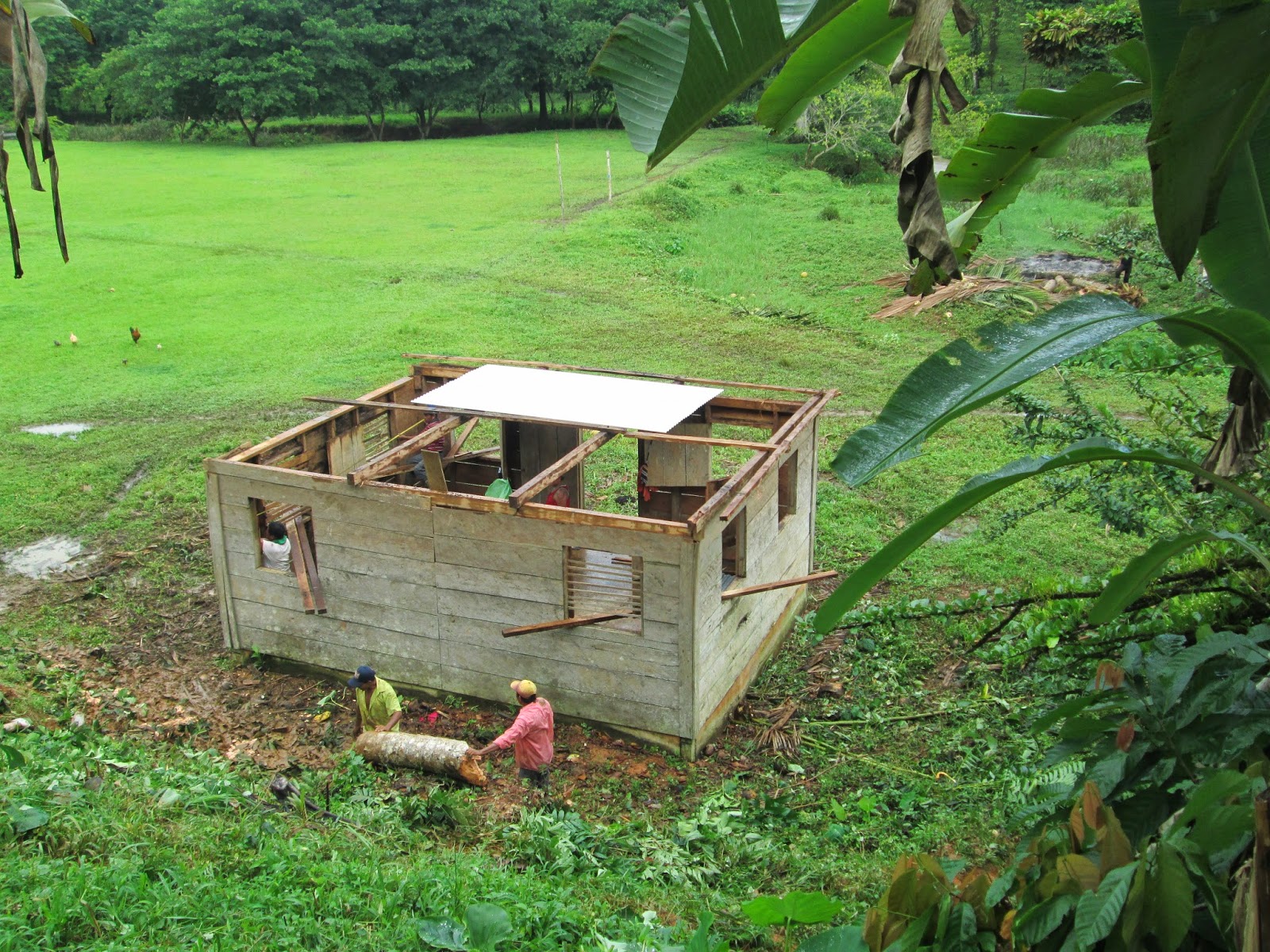
The month of July has also been dedicated in preparing my house for move in. The house needed a new roof; prior it was made of a tree called penca but penca is very far away in the farm so I bought zinc for the new roof. It has been quite the task of organizing the community to help construct, gathering materials, and working around the rainy season. I do not think all countries in Peace Corps require house building, but in Panama there seems to be various volunteers who need to construct their homes or make major repairs. To any prospective volunteers, if you can avoid it I would highly recommend not building a house. Peace Corps budget is next to nothing, and unless you are constantly haggling your community to finish the house, it won't be done in less than 3 months. I have heard other frustrating stories from volunteers and renting an unoccupied house tends to be the cheaper and easier route. Fortunately I did not have to make my house from scratch; nonetheless it was still a very frustrating and slow process. But it is more or less finished (apart from all the goodies I want to add like a garden). More pictures of the finished project to come soon
Original roof made of Penca. Here it is molded and full of holes

Taking down the Penca

Burning Penca


Starting to rebuild the skeleton and put on the zinc